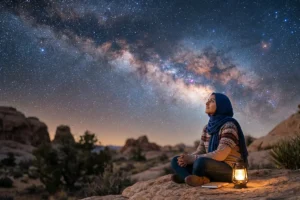

A Journey Toward Truth
Every human being, at some point in life, asks the ultimate question: Why am I here, and what is the truth?
Islam invites you to seek the answer—not blindly, but through reflection, observation, and reason. Unlike ideologies that demand faith without understanding, Islam encourages you to think, question, and explore.
“Indeed, in the creation of the heavens and the earth are signs for those of understanding.”
(Qur’an 3:190)
This article presents clear evidence for Islam — through logic, science, history, language, and the human experience.
1. Rational Proofs: The Logic Behind Faith
The first evidence lies in reason itself. The universe operates with perfect order and precision — from the laws of physics to the balance of ecosystems. Random chance cannot logically account for such harmony.
- Can something come from nothing?
- Can order arise from chaos without intelligence?
- If the universe had a beginning, who initiated it?
The Qur’an repeatedly appeals to human intellect:
“Were they created by nothing, or were they themselves the creators?”
(Qur’an 52:35)
Reason leads us to acknowledge that there must be a Creator — infinite, all-knowing, and purposeful. Islam simply calls Him Allah.
2. Scientific Evidence: Signs in the Universe
Long before modern science, the Qur’an revealed knowledge that could not have been known in the 7th century. These are not random coincidences, but signs pointing to divine authorship:
- The Expansion of the Universe:
“We built the heaven with power, and indeed, We are expanding it.” (51:47) - Embryology:
“We created man from a drop, then a clot, then a lump.” (23:12–14) - Mountains as Stabilizers:
“Have We not made the earth as a bed and the mountains as pegs?” (78:6–7) - Seas with Barriers:
“He released the two seas, meeting side by side. Between them is a barrier they do not cross.” (55:19–20)
Such verses align remarkably with scientific discoveries made centuries later — an undeniable indication of divine origin.
3. Historical Evidence: The Messenger and the Message
Prophet Muhammad ﷺ was known as Al-Amin — “the trustworthy” — even by his enemies.
He was illiterate, yet brought forth the Qur’an — a book unmatched in eloquence, wisdom, and foresight.
- He gained no wealth, power, or status from claiming prophethood.
- His message transformed illiterate tribes into a civilization that led the world in knowledge.
- The Qur’an remains unchanged for 1400 years, preserved word-for-word in its original language.
“We have sent down the Reminder, and indeed, We will preserve it.” (Qur’an 15:9)
No other scripture in human history can make this claim.
4. Linguistic Evidence: The Miracle of Expression
The Qur’an’s language itself is a miracle. It challenged the greatest Arab poets of its time:
“If you are in doubt about what We have revealed, produce one chapter like it.” (Qur’an 2:23)
No one has ever met this challenge. Its structure is neither poetry nor prose — a style unique and inimitable.
Its rhythm penetrates the heart, and its meanings unfold deeper with every reading. Linguists, believers and skeptics alike, agree: no other text compares to it.
5. Spiritual and Experiential Evidence: The Proof Within
Beyond logic and science lies a truth every soul can feel.
When one submits to Allah, there is peace — not just in mind, but in the heart.
“Verily, in the remembrance of Allah do hearts find rest.” (Qur’an 13:28)
Islam transforms lives. Millions of converts worldwide testify to inner healing, discipline, and clarity they never found elsewhere. The most profound evidence for Islam is often experienced, not just understood.
6. The Expansion of the Universe
“We built the heaven with power, and indeed, We are expanding it.” (Qur’an 51:47)
Centuries before Edwin Hubble discovered that galaxies are moving apart, the Qur’an explicitly mentioned the continuous expansion of the universe — a fact confirmed by modern cosmology.
Human Embryology
“We created man from a drop of fluid, then a clinging clot, then a lump of flesh.” (Qur’an 23:12–14)
This verse accurately describes the stages of human embryonic development — details discovered only through the use of microscopes in the 20th century.
Mountains as Stabilizers
“Have We not made the earth as a bed and the mountains as pegs?” (Qur’an 78:6–7)
Modern geology confirms that mountains have deep roots, stabilizing the earth’s crust — precisely as the Qur’an described over 1,400 years ago.
Seas with Invisible Barriers
“He released the two seas, meeting side by side. Between them is a barrier they do not cross.” (Qur’an 55:19–20)
Oceanography later discovered that when saltwater and freshwater meet, a physical barrier prevents them from mixing immediately — a phenomenon unknown in the Prophet’s time.
The Layers of the Earth and the Heavens
“It is Allah who created seven heavens and of the earth the like of them.” (Qur’an 65:12)
This verse implies both the layered structure of the earth (crust, mantle, core) and the multiple levels of the atmosphere — an astonishingly accurate description that aligns with modern science.
The Sun’s Orbit and Movement
“And the sun runs on its fixed course for a term appointed.” (Qur’an 36:38)
For centuries, people believed the sun was stationary. Now, we know it travels through space at tremendous speed, exactly as the Qur’an described.
The Moon’s Reflective Light
“Blessed is He who made constellations in the sky and placed therein a lamp and a moon giving light.” (Qur’an 25:61)
The Qur’an distinguishes between the sun’s light (lamp) and the moon’s reflected light — a detail confirmed by modern astronomy.
The Water Cycle
“And We sent down rain from the sky in due measure and caused it to soak in the earth; then We bring forth plants by it.” (Qur’an 23:18)
This describes the complete water cycle — evaporation, condensation, and precipitation — centuries before it was scientifically understood.
Plant Pairs and Reproduction
“And of all things We created pairs, that you may reflect.” (Qur’an 51:49)
Even plants reproduce in pairs (male and female parts) — a fact revealed by the Qur’an long before the discovery of plant reproductive biology.
Conclusion: The Door Is Open for the Sincere
Islam does not demand blind belief. It invites honest reflection.
The evidence is all around — in the stars above, the heart within, and the book that speaks the truth unchanged for 14 centuries.
If you are searching for purpose, begin where reason, science, and soul meet:
Read the Qur’an, and let it speak for itself.
“This is the Book about which there is no doubt — a guidance for those conscious of Allah.” (Qur’an 2:2)